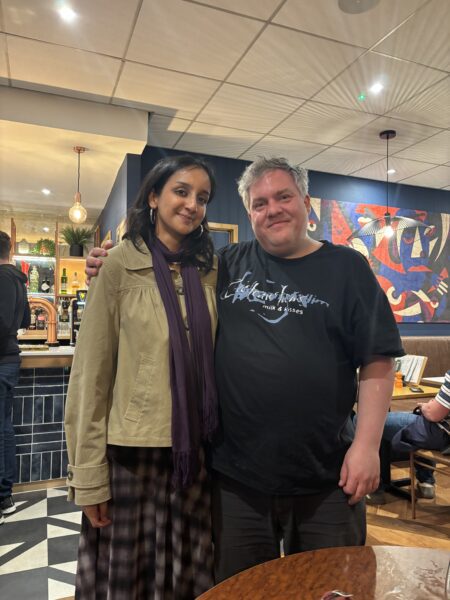


Daniel Land is a former University of Manchester student who escaped rural homophobia, survived a vicious breakdown at age eighteen, and is now turning his music into direct financial support for the charity that saved his life. His story is one about survival at a time when LGBTQ+ visibility and support still cannot be taken for granted.
His self-deprecating candour and intelligence are striking; his honesty in both his lyrics and his conversation creates a very open environment to ask some fairly invasive questions about his upbringing. Since Land regularly comes back to perform in his university city, one question surrounded whether his connection to Manchester influenced his musical development. “Yes, but not in an obvious way”, he answered. He described the bubble he grew up in, being born in 1980 in rural Devon, and coming to Manchester in 2000.
“For most of my youth, I never listened to the radio”, he said. “The music I listened to was always stuff that was about ten years out of fashion. Growing up, my mum introduced me to tapes in the car: Peter Gabriel, Tears for Fears, stuff that was just so deeply unfashionable. So it sounds so stupid now, but I came to Manchester knowing nothing about the Haçienda, knowing nothing about Happy Mondays or Stone Roses, that was just the wrong time for me at my age”.
What drew him to Manchester was the fact that he was too scared to apply to Oxford and Cambridge. Funnily enough, he also cites Queer as Folk, the Channel 4 drama series set on Canal Street as a source of inspiration. “As a gay person growing up in the sticks, I watched Queer as Folk, and I thought, yes, I’ll have a bit of that”. In Devon, where Land describes the gay scene as “about three people”, it was liberating for him to see so much representation on prime-time television.
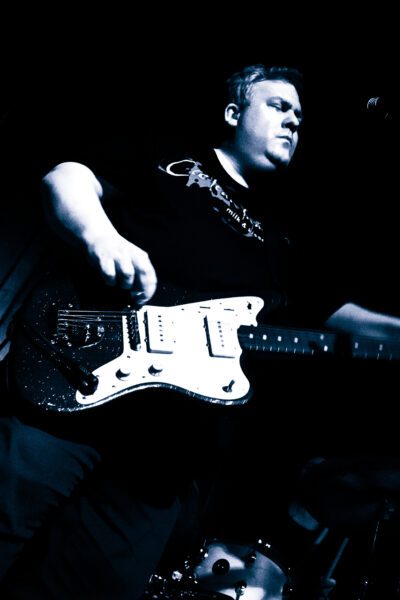
It was only in retrospect that Land realised that Manchester has not only a massive musical heritage, but a literary one as well, serving as a huge source of inspiration to him. “I got really into Anthony Burgess; he studied here. It was just complete naivety on my part, really, almost picking a name out of a hat. And it was a means to an end, a way to escape Devon and my upbringing”.
Land produces a wide range of music; he’s undefinable. His musical journey began firmly rooted in shoegaze, but he has drifted into dream pop and ambience. Under the alias riverrun, Land has released a series of instrumental albums, inspired by the Somerset coast. I asked him how much place impacts his music, and whether he felt that creative differences were contingent upon his location, since he’s now based both in London and the rural south. “In one respect yes, and in one respect no”, he dwelled on it for a while, “it’s completely inescapable from geography in the sense that the yearning to make music probably would never have come if I hadn’t grown up in quite a restrictive environment. And that has become an increasingly important theme to me as I’ve tried to deal with things more honestly in song”.
Speaking about his mental health, Land notes that music is no longer really a form of escapism for him. “I mean, I’ve had so much therapy at this point, and I’m not even really sure if it’s about dealing with things anymore. It’s more about asking myself what I want to say. You know, it took me the longest time to work out what I was actually good at. I was 35 years old and four albums into a career before I realised that actually what I do is fine. I shouldn’t try to hide it, I should actually try and just expand what’s there already, you know?”
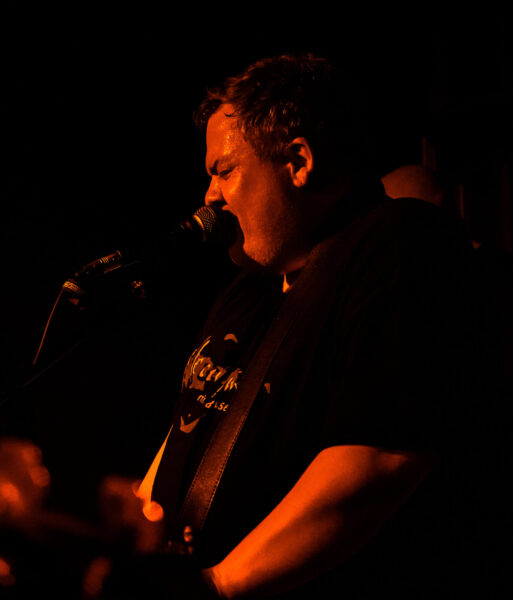
The experience of coming out in the wake of Section 28 shaped Land’s upbringing. He’s currently in the process of writing a memoir about his experiences as a young gay man in a very rural area. Listening to his music, you can see those themes as he puts himself back in that headspace. “It takes you so long to understand your own past”, he notes. “Place is important in that sense. I’m really understanding now, with the distance of twenty-five years, what it was like growing up in a homophobic environment in the nineties, and the impact that it had on me”.
The proceeds from Land’s latest single, ‘Snowdrops’, are going towards The Intercom Trust, a charity founded in 1997 to promote visibility and harmony in South West England. There was a great deal of silence on discussions of gay people and gay rights in the early-to-mid nineties. In 1988, the Thatcher government passed the Section 28 legislation, which banned the promotion of homosexuality. “It was a deliberately, maliciously, vaguely worded piece of legislation, and there was just no representation”, Land explains. “So I sort of grew up in this kind of historical lull. The one gay person that we knew of was Freddie Mercury, who died of AIDS, naturally”.
The Intercom Trust has addressed gaps in wellbeing services for LGBTQ+ people in South-West England from the late nineties to the present day. “There’s no Canal Street, no Gay Village in Devon. There are still pockets of isolated rural homophobia; it’s not safe for you to just go to any counsellor. And I was involved with them. Dr Michael Halls, the main guy from the charity, basically helped me put my life back together after I had my breakdown at the age of eighteen. So, I’ve always wanted to do something to pay it back”.
Land opened up about his breakdown, the main subject of his autobiography: “the story here is that I was in a relationship with basically the only other gay guy in the village. It was a disaster because everything was against us.’ He asked with emotion, “can you imagine what it’s like to find out that your partner, their seven-year-old brother, is being beaten up in school because you’re in a relationship with them? It’s terrifying”.
Land’s story is more important now than ever. Reflecting on the current political state of the world, he discussed how easy it is for things to backslide. “It doesn’t take much. All it takes here is a Reform government, and all of a sudden, people have got the pitchforks out again. It’s something that’s incoming”, he warns. “And it is present”. Even though Land was subject to such intense hatred in the West Country, he has found a way to appreciate the area now. “I have been going back there a lot. The last album was mostly made in a static caravan on the Somerset coast. Having lived in cities for so long now, there is something about the quiet that you get in the country, the slower pace of life, that’s become something really valuable to me. To get away from the city grind and be able to actually think”.
His perspective on the challenges he’s faced is emblematic of his maturity now, as he approaches his past and the people in it with empathy. Having been looking at his life through the rear-view mirror, Land reflects on what his favourite writer, Edmond White, calls the “pederasty of autobiography”, involving a feeling of strange disconnection from your younger self: “you know, that person was a 25-years-younger version of me. And the people I’m writing about were 25-years-younger versions of themselves. And there’s a great deal of forgiveness and compassion that comes through. Somebody can really mess you around; you can be in a relationship that goes really, really badly. But when you look back, you think, well, that person, like everybody, is just trying to do the very best that they can in their current situation. And that allows you to forgive yourself as well. And I beat myself up about everything all the time, but sometimes you just need a bit of a line in the sand to say, look, it’s actually okay”.
“I’ve been writing about my past in what I hope is a more honest way. And the bands that I like, the bands whose lyrics I respect, always seem to come from a baseline of curiosity about other people, but also compassion and forgiveness for them. I’ve known some people in the music industry who make petty songs about other people, or taking the piss out of people they know and so on. I just think that’s a very shallow emotion, right? Everything else is a lot deeper than that. Passion, forgiveness, mercy, now that seems like an interesting thing to write about. It’s so easy to fall into bitterness. And don’t get me wrong, sometimes it’s right to be bitter. Some people are arseholes, are narcissists, right? But oftentimes when things fall apart, it just falls apart. And after a while, don’t you feel grateful to that person for their love, no matter how temporary it was? You learn something about yourself with every relationship, and hopefully every time it gets a little bit better”.
I can only hope that I’ve done Land’s story justice; his emotions resonate. He is someone unique, a survivor, someone who doesn’t quite fit the mould. Within the shoegaze and dreampop genres, Land’s authenticity makes him the kind of person you can learn something from, as long as you open your heart to him because his heart is already open to you. You can hear that in his music, and you can feel the emotion when he’s singing. Music is in his very being; it’s the fabric of his makeup. In his own words, “you play the cards that you’re dealt, and even if it feels a little bit embarrassing at times to be this big sort of chubby guy singing about his ex-boyfriends, it’s the only thing that feels honest”.
You can be told that homophobia is a bad thing, but not really understand how it impacts a person’s life. Someone’s younger brother gets beaten up. They have a breakdown. They attempt suicide. They’re not able to concentrate at school. They give up on going to university, because they have no self-worth. This is what’s important to Land.
All proceeds from Land’s latest single ‘Snowdrops’ are going towards The Intercom Trust. If any themes from this interview have struck a chord, Pride Action North can be contacted at 0333 242 7307, or via the email [email protected]. If you live in the south west, you can get in touch with The Intercom Trust at 0800 612 3010.