


Viraasat (विरासत). In English, this word loosely translates to heritage, which is to inherit, or to pass down. While the word can be used in various contexts, I use it quite often when I refer to my collection of jhumkas and chaand balis, traditional Indian earrings passed down from my grandmother to my mother, and then eventually to me.
The word ‘jhumka’ comes from the word ‘jhumki’; the translation can be observed in the tinkling sound they make and their classical shape, typically involving a hollow bell with beads hanging at the bottom. Chaand balis, on the other hand, are named after the moon (chaand) which can, yet again, be observed in their crescent moon shape.
Depending on the metal they are made of and the gems that adorn them, they can be priced anywhere from £3-3000+, and if you were to visit India and find a local vendor at a street market (like Colaba Causeway in Mumbai), you could find them at an even cheaper price — provided that, like most Indian mothers and aunties, you knew the art of bargaining.
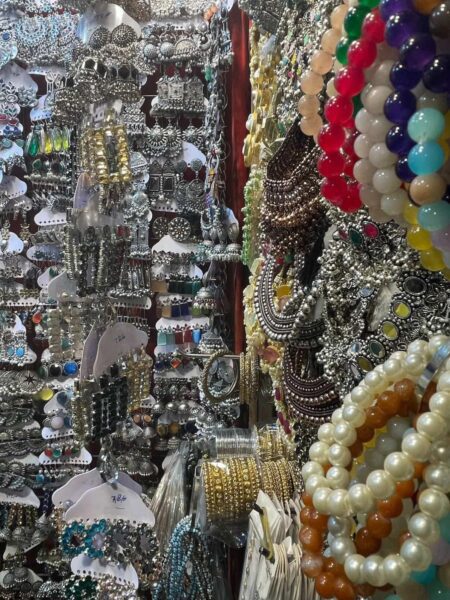
However, chances are that you already own a similar pair of these earrings, especially if you like ‘vintage jewellery’ because they often end up in charity shops, or can be found at your nearest Urban Outfitters store, where they are sold under the alias of “ornate boho earrings” for the measly price of £18!
So, what’s in a name, you ask? For me, the jhumka is a cultural symbol, and along with its material weight it also holds the weight of thousands of memories – from being able to wear my mother’s pairs to buying my own at a local market to borrowing one of my friend’s pairs and forgetting to return them, I consider the jhumka to be at the centre of the ongoing debate of misplaced credit in fashion.
At Paris Fashion Week, Ralph Lauren’s Fall 2026 collection, which left people in awe, featured ‘authentic vintage accessories’ – which, you guessed it, were jhumkas. While western media has not yet caught on to the blatant erasure of the craftsmanship behind the accessories, the Indian media has not been silent. From well recognised news agencies to micro influencers to your average college going girl who puts on her jhumkas everyday with her kurti and jeans, everyone has expressed their disappointment in the luxury fashion house and expect credit to be given where it is due.
This is, however, not the first time that Indian fashion has been transformed into something palatable. In June 2025, Prada showcased £800 ‘leather sandals’ with a toe-loop design, which were identical to the Kolhapuri chappals (sandals), a style of footwear native to the Indian states of Maharashtra and Karnataka. A Guardian article states that the Maharashtra Chamber of Commerce complained on behalf of the thousands of local craftsmen who were disheartened by the lack of mention given to their craft.
After receiving a lot of backlash online and being accused of appropriation, Prada’s corporate social responsibility chief wrote back to the Chamber, “We acknowledge the sandals … are inspired by traditional Indian handcrafted footwear, with a centuries-old heritage,” and later signed a deal to produce 2000 chappals in India. What begs the question is that if the controversy hadn’t caused such an uproar online, would the credit be given?
There have been designers who have done it right – who have taken inspiration, the fabric, the patterns and made it their own, all the while acknowledging Indian craftsmanship and culture. In 2023, Hamish Bowles curated the ‘India in Fashion’ exhibit at the NMACC in Mumbai. Imagined by Patrick Kinmonth and Rooshad Shroff, the exhibit included hundreds of looks from various Indian and Foreign designers – Sabyasachi, Dior, Chanel, Valentino, and Jean Paul Gaultier to name a few – showcasing the influence the subcontinent has had on fashion as we know it.
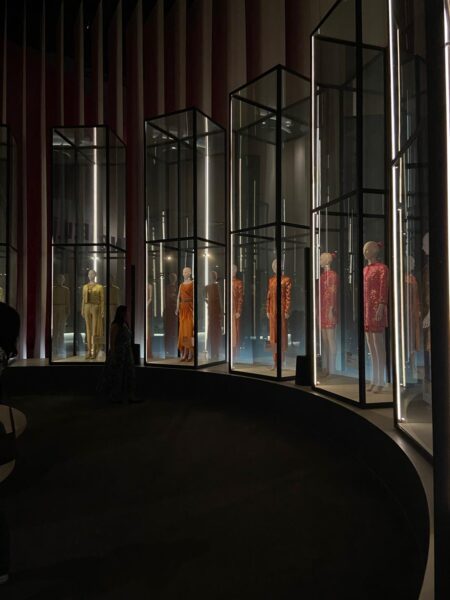
In conversation with Vogue India, Partick Kimmonth said he “[hoped] they’ll see how absolutely central India has been to high fashion since 1750, the mid 18th century, because we have clothes here from 350 years ago.”
But it isn’t just the earrings or the chappals that have had a tragic renaming, the trend of erasing cultural roots of Indian fashion has been going on for around 300 hundred years, and is first observed in the renaming of prints and patterns.
Chintz originates from Golconda, Hyderabad, Seersucker was called Shir-o-Shakar, the Paisley motif originates from Kashmir, the tie-dye technique originating from Gujarat called Bandhani was adapted by the West under the name of Bandana. Designer Ritu Kumar is one of the many people to comment on how the Industrial Revolution in the 18th century enabled the British to try and replicate Indian textiles, which they sold back to the Indian sub-continent. The handlooms of the Indian artisans couldn’t possibly keep up with the textile industry of Britain, leading to a near extinction of Indian fabric.
Today, a similar whitewashing can be observed on online platforms, which have become center stage to the erasure of Indian identity from various fashion trends. The term ‘Scandinavian scarf’ has been widely used for what we call the Dupatta, a piece of cloth that is central to almost every Indian outfit. Prior to the Scandi scarf, Kurtis were widely referred to as ‘Boho tunics,’ Bindis were called ‘face gems’ and were widely worn during Coachella and other music festivals, and Mehendi or henna was popularized under the name tag of ‘temporary tattoos.’
While fashion has always been an art, and art inherently takes inspiration from various cultures, the fashion industry also has a vast history of appropriating Brown culture. This is especially annoying when the Brown community typically doesn’t find any representation on the runway, and when most of us often face backlash for ‘dressing too Indian,’ for wearing the same dupatta that you call a Scandinavian scarf.
Each ‘accidental’ account of erasure weaves a larger web, reminding us that the fluidity of fashion often comes at the cost of local identities and artisans. In a time when the effects of the same aren’t as visible, only appearing on our feeds at 30-second intervals, calling it what it is does matter. So, the next time you see ‘vintage earrings’, I hope you call them jhumkas. The next time you buy a pair, I hope you try and buy them from a local craftsman.


