


Long live dinosaurs. That’s the sentiment Hollywood has been trying to bloodily smear into our brains through the myriad of mediocre dinosaur films that followed Jurassic Park becoming the biggest film ever in 1993. With its lackluster sequel – one Steven Spielberg himself admits failed to live up to the original – often being cited as the pinnacle of this particular corner of creature features since then, onscreen dinosaurs have been fated to eventually face the same end as their real-life counterparts: total extinction.
Enter David Robert Mitchell.
Set in the fictional town of Flowervale of 1980s American suburbia, The End of Oak Street follows the nuclear Platt family – parents Denise (Anne Hathaway) and Greg (Ewan McGregor), their two kids Audrey (Maisy Stella) and Brian (Christian Convery), and their dog Starbuck (interchangeably played by real-life thespians Brisket and Buzz) – living through the bubbling fractures of a strained marriage, financial troubles and teen drama, as their neighbourhood is pulled into prehistoric times. Mitchell writes and directs, with J.J. Abrams producing through his currently downsizing production company, Bad Robot.
The End of Oak Street begins with a memorable, light-hearted with a pinch of danger Michael Giacchino tune playing over the opening logos. This, followed by a nostalgic introduction to the family’s suburban life at a block party, immediately keys the audience into a film capturing the comforting tone and vibe of ’80s Amblin pictures.
The topic of struggling marriages isn’t unfamiliar to those films either. E.T. – the film whose iconography is the literal logo of Amblin Entertainment – centres on a lonely kid in the fallout of his parents’ divorce. Oh, and did I mention this film takes place in 1982, a.k.a. the same year E.T. released? All this isn’t to accuse Mitchell of not so subtly borrowing from Spielberg, but rather to showcase how he leverages the audience’s connection to the iconic suburban family image created by those films to waste little time in the pre-inciting-incident portion of this already-tight 99-minute romp.
Greg constantly deflects his marital troubles, much to the dismay of Denise, who’s writing a self-insert fiction novel about a mother yearning to leave her family over feeling the trappings of being a suburban housewife. The year of Anne Hathaway continues as she proves to be the unsurprising standout here, completely selling Denise’s unconditional love for her family amidst their turbulence, and being the Platts’ resident badass when the action starts.
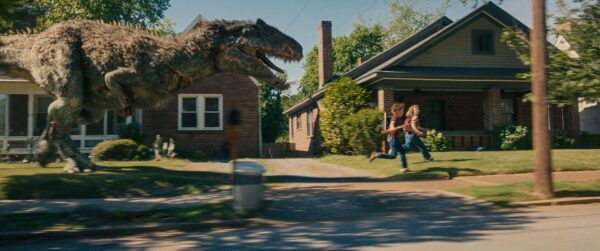
Once the engulfing cosmic glow finally tosses Oak Street into the past and the action does start, it’s satisfying. Mitchell and cinematographer Mike Gioulakis deploy throwback techniques, using split-diopter lenses and unbroken action takes to show the emerging prehistoric threats in the background of the exterior shots, truly capturing the feeling that they’re invading what is supposed to be a safe space for the suburbanites.
The traditional reptilian take on cinematic dinosaurs has been substituted for the more accurate feathered dinosaurs – sorry, scales! These fresh dinosaur looks soften some of the scarier edges associated with these creatures, supporting Mitchell’s vision of keeping the high-octane chases and close-quarters scares – for the most part – family-friendly.
The film’s most memorable moments, however, come during those short bursts of shocking violence. An innocent neighbour getting her head chomped off by an emu-like dinosaur led to some jolted popcorn spillage a few seats down the aisle. Plus, the film’s most talked-about dinosaur set piece – kicked off with Denise fighting off an in-pursuit allosaurus with a shotgun – ends on a bloody, emotionally devastating turning point for the Platt family.
How and why they’ve ended up in the past – mysteries one can’t help but speculate about – is scarcely the focus here. The script keeps any explanations for the time-bending mechanics relatively straightforward, and is unbothered about providing any real thematic reason to underpin the clever sci-fi premise. Hungrier moviegoers may find that disappointing, but I found the film’s restraint in not forcing some revelation to preposterously recontextualise the cosmic anomaly refreshing, especially for an Abrams’ production. This also saves the movie from ever devolving into repeated mid-film exposition dumps that dance around in his oh, so beloved “mystery box” and risk halting the necessary momentum of a film committed to being the purest form of summer escapism. Don’t worry, there isn’t some conveniently-timed scene for Kylo Ren to show up and tell Rey that she’s Palpatine’s granddaughter.
My frustrations with Oak Street boil down to how it haphazardly builds and pays off audience investment. Mitchell’s distinct visual flair does wonders for the spectacle, but his medium shots and close-ups (including those in the opening party scene) often crowd the characters with too much negative space. There’s a sense of dread that comes from the spatial isolation born in these composition choices, as if the towering dinosaurs really could invade the frame at any moment. The problem is that it inadvertently works against Mitchell’s aim of inviting the audience into the family’s life, instead facilitating our emotional distance.
Each of the Platt teens are given what feels like the leftovers of ‘subplots’ from a longer cut and are mostly here to be typical dumb movie kids. Audrey is dealing with her parents not being able to afford her dream university, but this is never a legitimate point of conflict. Brian is targeted by a bully throughout the movie, and this obviously comes to a head when Brian decides to run after his dog alone in a town overrun by dinosaurs. These background elements are supplementing underwritten characters, and, as such, feel like half-hearted, insincere attempts to inject, well, heart.
Even the wrap-up of Denise’s arc rings hollow. Any complexity to her marital struggles is thrown away for a rushed climactic choice that – if anything – fails her as a character, all to fulfil that aforementioned promise of comfy Amblin vibes. Mitchell’s ending implies, whether intentional or not, that she herself was the sole cause of her doubts, alleviating any of the obvious shortcomings of her avoidant male partner. Even taking into account the gut-wrenching mid-film turns, leaving Denise on a note where most of her very real problems haven’t been properly resolved left a bad taste in my mouth. The script also ignores the morally questionable ramifications of Denise’s choice; that is, aside from a blink-and-you’ll-miss-it moment in one of the final frames that functions as no more than a lazy acknowledgement of them.
The End of Oak Street harkens back to what many consider a simpler era of blockbusters. The ‘simplicity’ of what they aimed to achieve – maximising audience joy – is often remembered without appreciating that the very best of those movies – E.T., Back to the Future and, yes, Jurassic Park – have only survived in the zeitgeist as long as they have because they reached deep into the hearts of moviegoers. By contrast, The End of Oak Street prioritises thrills over genuine emotional resonance at almost every turn, but it’s undeniably pretty good at doing so. And – considering the current state of dino pictures – “pretty good” is a big-bang event.
3.5/5


